Sunday, May 29, 2016

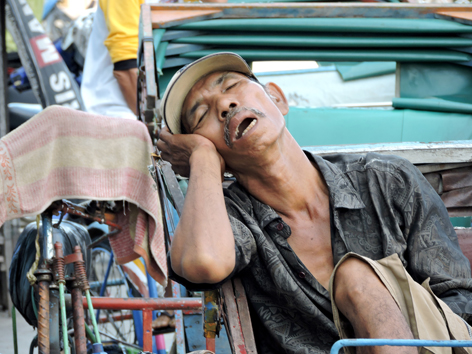
Sleeping on the Job

This man has a physically demanding job. He pedals his bicycle taxi to earn perhaps one or two dollars for every fare. He’s often honked at and nearly run off the road by cars and motorcycles who don’t want to be behind him. He’s in competition with several other becok drivers, many of whom drive taxis that have a motorcycle instead of a bicycle. While his seat for his passengers is shaded, he toils under the punishing sun. At the end of a good day, he may make $20.

Many people on Sumatra have a similar situation; they work hard and make very little to show for it. When asked why they don’t try something new these men often shrug and say, “This is all I know. What else is there for the likes of me?”

It’s a common situation the world-over; we get into our ruts of what we know and can’t imagine a different life. The life we have makes us weary but what else is there? Jesus invites us all to come to Him when we are weary; He offers us rest and companionship (Matthew 11:28-30). He promises a new life if we will first let go of our old lives for His sake (Matthew 16:25). This is the point where many walk away. Life may be hard, but at least it’s familiar. Instead of grabbing hold of a new life, many people on Sumatra sleep on and miss Christ’s invitation.

Pray for a spiritual awakening on Sumatra.

Pray for millions of Sumatrans to hear and head Christ’s invitation.

Pray for workers on Sumatra to not get discouraged by the sleepy apathy of those they share the Gospel with.

Friday, May 27, 2016

Keeping in Step

These Junior High School girls are participating in a regular exercise at their school. They march through the streets of their town and sing together as they march. The purpose of the exercise is exercise, but it’s also meant to build unity within the school and community. Being out of step with the values of the school and community are highly discouraged.

Community pressure to stay in line is one of the tools to keep the young from rebelling and falling into negative behaviors. The idea of being part of something bigger than yourself is indoctrinated into the thinking of Indonesian children from a young age.

Religion is a key part of community identity. Anyone deviating from the norm will receive pressure to fall back into line. Those who refuse to fall back into line are often persecuted by family and community. The cost of being different is often too much for individuals to bear. It’s perfectly okay to be nominal in your adherence to religion, just don’t break ranks with the rest.

Pray for new believers who are being persecuted for breaking ranks.

Pray for more Sumatrans to understand the value of the Gospel so that they are willing to pay the price of being a follower of Jesus.

Pray for workers to have wisdom, courage, and access to help new believers in the midst of persecution. When persecution starts, workers often lose contact with new believers.

Sunday, May 22, 2016

Made to Soar

Sumatrans love to own birds as pets. Most of the birds are small and colorful, but on occasion you might see a big bird of prey like this Golden Eagle. There is something wrong about seeing a majestic bird like this caged. Eagles weren’t made to be caged. They were made to soar!

What is more tragic, birds like this who have been in captivity for a long time forget how to soar. They learn to accept being caged, and may even be fearful to leave their cage. The cage is what they know, and the unknown is scary. Freedom does come with risk and responsibility, but the benefits are far better than captivity.

In a like manner, God didn’t create man to be caged, or enslaved by sin. As an image bearer of the Most High God, man was made to for freedom; to live nobly before the Lord. Many Sumatrans live lives not much different than this caged eagle. They are working to earn forgiveness of sin, but instead of finding freedom the chains are getting thicker and heavier. When they are told of a way to freedom that doesn’t depend on what they do, but on what Christ has done they often reject it. They are comfortable in their self-made cages of religion and tradition, and the thought of being free doesn’t seem like Good News. It seems different, unknown, and scary. To them it seems wrong.

Isaiah reminds us that those who wait upon the LORD will mount up with wings like eagles (Isaiah 40:31). The peoples of Sumatra will never experience this unless they are first willing to let go of what they have in order to receive what God wants to give to them.

Pray for those caged by sin on Sumatra to hear the Gospel and be set free to soar.

Pray for those who are already soaring to help the newly released to learn how to stretch their wings and soar.

Pray for the caged on Sumatra to desire freedom and to find freedom in Christ.

Pray that they will be willing to let go of the known in order to receive grace that is greater than all their sins. 

Sunday, May 15, 2016

Singkil Malay People Group Profile

“Enter by the narrow gate. For the gate is wide and the way is easy that leads to destruction, and those who enter by it are many” (Matthew 7:13-14, ESV).

The 65,000 Singkil Malay live in the southern part of Aceh Province in northern Sumatra. The Singkil Malay Kingdom was once a rival power to the Acehnese Kingdom. Currently, the Acehnese culture dominates the entire province. However, the Singkil fondly harken back to days prior to Acehnese domination.

Most Singkil Malay make their livelihoods as farmers and fishermen. They adhere to a patriarchal society and give great value to the opinions of the elders in the village. Their language shows connection to the Minangkabau. The largest Singkil clans are the Berampu and Tinambunan.


The Singkil Malay follow Islam mixed with animistic beliefs. They especially revere the grave of Abdul Rauf, who was a great religious leader from their history. Like many people groups on Sumatra, the Singkil often seek the magical power of the shaman or dukun.

There is no indigenous Singkil Malay church. Churches in the area have often been the target of community persecution.

Pray that:

Believers in Singkil will be empowered by the Holy Spirit to show love even in the face of persecution.

Workers will hear the call of God to live among and share the Gospel with the Singkil Malay.

Members of fanatic religious groups will encounter the risen Christ and will become witnesses to their own people group.

Elders in Singkil Malay villages will have dreams and visions of Jesus and use their influence to reach their villages with the Gospel.

The influence of Acehnese culture will not hinder Singkil Malay people from hearing and responding to the Gospel.

The influence of animistic beliefs will be broken by the power of the Holy Spirit.

An indigenous, doctrinally sound, rapidly multiplying Singkil Malay church will soon come into being.

Thursday, May 12, 2016

Grace for the Disabled

There is not much support on Sumatra for the medically disabled. This Lampung Pubian man suffered a stroke earlier this year, and has not been able to work since then. He has limited use of his arm and leg. Most disabled folks here on Sumatra end up begging on the streets. If family is unable to care for them, then they often suffer.

Nobody wants to be absolutely dependent. People like to pull their own weight and be productive. This natural independence makes many people resist the Gospel. In order to receive the Gospel people must realize their inability, or even their disability. Jesus cannot save those who think they are strong enough to “pull their own weight.” Only the poor in spirit, those unable to do it on their own, will inherit the Kingdom of God.

Pray for disabled people on Sumatra to be treated with dignity and care.

Pray for Sumatrans to realize their absolute dependence on Jesus to deal with their sin debt.

Pray for believers here to be burdened to show the love of Christ to the disabled.

Sunday, May 8, 2016

Give Me One More!

To what can I liken the work of a prayer mobilizer? He is like a captain in charge of the battering ram during the siege of a powerful, well-fortified city. His job is to bring the battering ram of prayer to bear on the gates of the enemy’s stronghold. He and his troops are the focus of every enemy archer on the ramparts. The burning pitch and rocks hurled from the battlements are aimed at them. Yet, to win the war the gate must be shattered. Because of the hazardous nature of the mission, this captain must enlist volunteers willing to charge the gates. The captain must enlist a lot of soldiers, because most of them won’t last for long.

“A bit melodramatic, don’t you think?”

“No, I don’t think it is.” Many people enter into intercession for Unreached People Groups (UPGs) casually, as if it was not that big a deal. Suddenly, things start going wrong. They have problems at work. The car breaks down. The air conditioner has to be replaced. The kids start acting up. The dog dies. Someone gets sick. And they stop praying and never see the connection. Or worse yet, they give up because they get bored. They expected a quick victory and weren’t ready for the long-siege. They weren’t ready for the fiery darts of the enemy.

Praying for UPGs is not like getting into a jet fighter, cursing in at 15,000 feet, pressing a red button, and watching a smart bomb take out the target. If you’re praying for a UPG, you’re taking up the battering ram. You become the enemy’s target.

“Well that’s certainly encouraging!”

“No, it’s not meant to be. But it’s realistic and in line with what I’ve seen mobilizing prayer over the past 12 plus years.”

Here’s how it works. To mobilize prayer you first have to get the prayer requests. Every month I send out reminders to workers to send in their strategic prayer requests. On average 40 percent or more don’t reply for a variety of reasons. So I take what I get and put together prayer guides, calendars, and people group profiles. And then I send the tools by email to over 650 people representing over 100 churches. As I send the email it is like I’m yelling, “Okay, on three. One, two, three, PRAY! BOOM, the battering ram of prayer smashes into the enemy’s gate!!”

Yet every month we have people unsubscribe. I think about the 40% of my co-workers who are not asking me to mobilize prayer. I wonder what they’re facing. Then I cry out to God, “Oh LORD, send me another intercessor to pray for the workers on Sumatra. Just send me one more today!”

There are 53 UPGs on Sumatra with over 40 million souls in them. As I coordinate photos and scriptures to post prayer requests on Facebook I am often overwhelmed by the lostness on this island. We currently have over 380 people who “like” our page. Last month we had over 6,700 hits on our posts. How many prayers does that translate into? I have no clue. But every time I hit post it’s like I’m yelling, “Okay, on three. One, two, three, PRAY! BOOM!!

Thousands of hits is great, but tens of thousands would be better, especially if it’s people that are praying. There are 15 people groups on Sumatra that are unengaged. I think about them and wonder how long before they will get the chance to hear the Gospel? Then I cry out to God, “Oh LORD, send me another intercessor to pray for the peoples of Sumatra. Just send me one more today!”

The church on Sumatra is often fearful and inward focused. Many Sumatran pastors are unsaved and don’t know the Gospel. Many other Sumatran pastors are more concerned about building a bigger meeting house than in reaching the lost. Precious few are interested in learning how to pray for and share with the UPGs of Sumatra. Those who do reach out, and those who believe from among UPGs are often persecuted. As I go to Twitter, I often mobilize prayer for the apathetic and the persecuted church on Sumatra. With every tweet it’s like I’m yelling, “Okay, on three. One, two, three, PRAY! BOOM!!”

I put together a virtual prayerwalk and post it on Vimeo. PRAY! BOOM!! I write a culture article and post it to the secure web page or to Blogger. PRAY! BOOM!! I pin another link for prayer to Pinterest. PRAY! BOOM!! I redo Fast Facts or prayer maps. PRAY! BOOM!! I journey out to gather 1,500 to 3,000 photos, prayerwalk, and share the Gospel with 200 people from 10 different UPGs within an average year. PRAY! BOOM!! I lead a prayer seminar at a local church. PRAY! BOOM!! I sit on the floor on a straw mat at yet another prayer meeting. PRAY! BOOM!! I produce scripture photos for Instagram. PRAY! BOOM!! I produce a prayer card or photo video for a field worker. PRAY! BOOM!! I write and design a Ramadan prayer guide and an Advent prayer guide and distribute them. PRAY! BOOM!! With every prayer request I plead with God. Send me one more to pray for the cities. Send me just one more to pray for the children. Please LORD, send me another intercessor for Sumatra today!

If you’re still reading, you’re likely one of my prayer warriors who’ve been charging the gates with me for the past six years. I know you’ve taken hits from the enemy for your efforts to bring down the gates and set the captives here free. I salute you, soldier.

The enemy gate still looks strong, but let’s keep on hitting it. With God’s help, who knows, it might fall with our next stroke. The fires of spiritual awakening might be ready to sweep from Aceh to Lampung. Millions of souls might be on the verge of being swept into the Kingdom. Don’t lose heart!

“So, what you’re saying is you pray and make prayer tools.”

After pulling an enemy arrow out of my shoulder, I grimace and then staunch the wound. I smile sweetly and say, “Yeah, something like that.” Then I turn to my troops and shout, “Okay, let’s hit it again on three, and give it all you’ve got this time!”

“For we do not wrestle against flesh and blood, but against the rulers, against the authorities, against the cosmic powers over this present darkness, against the spiritual forces of evil in the heavenly places” (Ephesians 6:12, ESV).

Pray for the gates to come down and the enemy strongholds to be demolished in Sumatra.

Pray for just one more intercessor every day to pray for the peoples, for the churches, for the persecuted, for the cities, for the children, and for the workers in Sumatra.

Pray for Sumatra’s prayer mobilizer to be strengthened in the LORD and filled with the Spirit.

Pray that intercessors will not lose heart until, with God’s help, we see the enemy’s gates fall.
Wednesday, May 4, 2016

Aneuk Jamee People Group Profile

“But Ruth said, ‘Do not urge me to leave you or to return from following you. For where you go I will go, and where you lodge I will lodge. Your people shall be my people, and your God my God’” (Ruth 1:16, ESV).

The 65,000 Aneuk Jamee are a small and secluded people group on the west coast of Aceh Province in northern Sumatra. Their local dialect is Minangkabau, because they are descendants of people who migrated from Padang. Aneuk Jamee means “children of guests” in Acehnese.

The Aneuk Jamee earn a livelihood primarily from fishing, farming, and trading. Most of the fishing boats in the area are owned by Acehnese or business interests from Medan. There is a great need of economic development among this people group.


The Aneuk Jamee are predominately Muslim with a mixture of pre-Islamic animistic beliefs. It’s common to consult the spiritual leaders called dukuns for enchantments, curses, or healings. There are few known believers and no indigenous churches among the Aneuk Jamee.

Pray that:

Workers will hear and surrender to the call to reach the Aneuk Jamee with the Gospel.

Satan’s strongholds will be identified and brought down by specific, persistent intercession.

People of peace among the Aneuk Jamee will be identified by Spirit-led workers.

Gatekeepers to Aneuk Jamee areas will show favor to workers as they enter this unengaged area.

Aneuk Jamee believers will be gathered into house fellowships and taught to become passionate, vibrant followers of Jesus.

The first indigenous Aneuk Jamee church will be birthed soon.

The Aneuk Jamee, like Ruth, will have the loyalty and desire to follow the One True God no matter what.

Sunday, May 1, 2016

Cosmopolitan Sumatra

These three high school boys are from three different people groups. The boy in the red is Minangkabau. The boy with 91 on his sleeve is Acehnese. The boy on the right is Javanese. There is another boy at the top of the picture frame. He is from yet another people group – Jambi Malay. This scene is not unusual in the cities of Sumatra. Many cultures meet and mingle in the cities.

The challenge of reaching people in the cities remains an enigma. All of the major response to the Gospel on Sumatra has come from rural areas among predominately homogenous groupings of people. Workers have tried several strategies to reach peoples in the cities, but none have been overly successful.

Because the cities have a lot of mixing of cultural ideas and identities it would stand to reason that the Gospel would gain an easier hearing, but that is not the case. Most people in the cities are more interested in seeking their fortunes than in hearing about their eternal destinies. City people are more mobile and have less time for chit-chat. They also tend to be more suspicious of people they don’t know. In effect, they are even more isolated and less open in the midst of a sea of humanity than those in hard-to-reach rural areas.

Pray for workers focused on the cities of Sumatra to be sensitive to the Spirit’s leading.

Pray for successful strategies to be developed for urban work on Sumatra.

Pray for the Gospel to be boldly and successfully proclaimed in Sumatra’s cities.

Pray for believers from among all 53 of Sumatra’s unreached people groups to be reached within Sumatra’s cities. 

Wednesday, April 27, 2016

PDA Rules

This Jambi Malay man was having some fun with the foreigner taking pictures in the traditional market. Many of the by-standers thought the man was funny for posing as if he were kissing the mannequin. Social etiquette in Sumatra regarding public displays of affection (PDAs) are much more conservative than in the states. It would be shocking to see a man kissing a woman in public other than on their wedding day.

In contrast, displays of affection between members of the same gender is normal. It’s not uncommon to see two men or two women holding hands, walking arm-in-arm, or even walking with an arm over the other’s shoulder. They don’t kiss on the lips, but women often greet each other with a peck on both cheeks. There are absolutely no sexual connotations to these PDAs.

The man likely posed as a joke about the sexual permissiveness in Western culture. This doesn’t mean that there isn’t sexual sin in Indonesia. It just means that God’s standard of sexual purity is more widely known and accepted, and that those who break God’s standards are still shamed by polite society.

Internet pornography is one of the hidden sins of many Sumatran youth. Parents are at a loss to know how to stop their children from this temptation of technology that they never faced because the technology wasn’t available to them.

Pray for Western workers as they struggle to break out of the stereo-typed view of Western men.

Pray for the hidden sexual sins of Sumatrans to drive them to confess their need of a Savior.

Pray for youth on Sumatra who have been caught up in the temptations of technology.

Thursday, April 21, 2016

Kerinci People Group Profile

“Arise, shine, for your light has come, and the glory of the LORD has risen upon you” (Isaiah 60:1, ESV).

The homeland of the 311,000 Kerinci is on the border of the West Sumatra and Jambi Provinces. Lake Kerinci and Mount Kerinci are notable landmarks in this lush jungle area. The Kerinci have a unique dialect from the Malay language family; they also have a distinct form of writing called Paku which is similar to old Javanese script.

Most Kerinci are farmers who grow rice, coffee, cinnamon, and various vegetables. Those who live near the lake often work as fishermen. The land is fertile, but the Kerinci could benefit from more modern farming techniques to improve their crop yields.


The Kerinci are Muslim with strong animistic influences. They fear spirits and use magic for protection and to bless their crops. Sexual permissiveness, prostitution, and widespread divorce are serious problems in Kerinci society that have significantly weakened the family. There are believers among the Kerinci, but they are a small minority who are trying to shine the light of Christ in the darkness surrounding them.

Pray that:

Kerinci believers will live holy lives and share a bold witness with those living around them.

The Holy Spirit will break the spiritual stronghold of lust that is destroying families among the Kerinci.

God will call and send a mature couple to live as cross-cultural workers among the Kerinci to help strengthen the believers and to reach out to the lost.

Indigenous Kerinci fellowships will rapidly reproduce amongst the Kerinci people.

God will call and equip more Kerinci spiritual leaders to shepherd the flocks, disciple the lambs, and seek out the lost.

Kerinci believers will stand strong in their faith and not use animistic charms or rituals when they encounter problems.

God will bless Kerinci believers so that those living around them will see that God is stronger than the spirits they fear.

Friday, April 15, 2016

Holy Frustration

These three Ranau men sat and talked with a worker about the problem of mankind’s sin debt. The worker shared about Isa Al Masih and His great sacrifice to pay our sin debt to God. The young man in the middle struggled to share about his beliefs. He sincerely wanted to see the worker come to his point of view, and the worker could see the frustration on his face.

When we hold a strong religious view it’s difficult to understand how people are unable to see what is so clear to us. This was the situation for this young man, and the worker identified with his pain. The worker was also touched that this young man cared enough to try and share his faith. After sharing with hundreds of people, only two Muslims have cared enough to try and share what they believe with the worker. Unlike America, religion here is not a private matter. It’s okay to talk about religion in polite society in Sumatra.

Ultimately, the issue isn’t about religion it’s about God and what He reveals as truth. The worker challenged the young man to pray to God and ask Him to reveal what road truly leads to heaven.  The worker also challenged the young man to pray for him that he too would know the truth and follow it with all his heart.

Pray with the worker that this young man will come to know the way, the truth, and the life.

Pray for workers on Sumatra to follow the truth of God with whole-hearted abandon.

Pray for workers dealing with the frustration of spiritual blindness among the people they share with to rest in the power of the Gospel and the work of the Holy Spirit. 

Monday, April 11, 2016

Run Free

These two Lampung Abung boys were playing at their Dad’s fruit stand in the traditional market. What this photo does not show clearly is that the 2 year old boy in the red shirt is playing with a sharp knife. It is a truism on Sumatra that children often have little supervision and are allowed a lot of freedom to do whatever they want. This freedom is both good and bad.

Many children on Sumatra are hungry for attention. This hunger makes them vulnerable to exploitation. The main form this exploitation takes is forced labor. But feelings of rejection from parents also open many Sumatran youth to drugs and sexual exploitation.

It is time intensive and physically hard to make a living on Sumatra. Parents are often stressed and stretched. They don’t have a lot of energy to put into their children. Education opportunities, especially in rural areas, are limited. So many children on Sumatra don’t have a lot of hope about the future.

Pray for parents on Sumatra to find strength and provision in Christ.

Pray for children on Sumatra to have positive opportunities for attention and for bettering their lives.

Pray for believers on Sumatra to model a better and more loving way of doing family.

Pray for believers who work as teachers to consider moving into areas that have Unreached People Groups to invest in the children. 

Tuesday, April 5, 2016

Transmigrant Javanese People Group Profile

“For my eyes have seen your salvation that you have prepared in the presence of all peoples” (Luke 2:30-31, ESV).

By far, the largest people group in the country of Indonesia is the Javanese. The most densely populated island in the Indonesian archipelago of over 13,000 islands is Java. For this and other economic reasons, the government sanctioned a massive relocation program during the 1970s -1980s in which millions of Javanese farmers moved to rural locations in Sumatra. Today, Javanese are located throughout the island. There are 15 million of them which makes the Transmigrant Javanese the largest people group on Sumatra - over twice the size of the next largest unreached group.

These farmers were asked to “tame the jungle” or work on Sumatran plantations. These transmigrants endured a broad spectrum of hardships; however, due to their hard work and perseverance, many have prospered. Most of the indigenous Sumatran tribes are prejudiced against these “newcomers.”


Most Transmigrant Javanese are Muslim, yet there are over 60,000 Javanese believers on Sumatra. That sounds like a lot, but it only represents .46% of the total population of Javanese in Sumatra. There are around 2,000 Javanese churches in Sumatra. Most Javanese believers don’t think about praying for or sharing the Gospel with the lost living around them. A spiritual renewal among the Javanese believers on Sumatra could have a large and far-reaching impact on the island.

Pray that:

God will bring spiritual awakening among the Javanese believers in Sumatra.

God will call many cross-cultural workers from among Javanese believers.

Training efforts among the Javanese believers will equip them to share with the unreached peoples.

There will be a massive turning of Javanese to faith in Jesus Christ.

The Javanese work ethic will be turned to building up God’s Kingdom.

Workers focused on the Javanese on Sumatra will have wisdom, boldness and perseverance.

The Javanese churches will rapidly multiply and carry the Good News to all the peoples of Sumatra.

Saturday, April 2, 2016

This Little Piggy

The pig is a divisive animal on Sumatra. Amongst the Nias and Batak cultures it is a symbol of wealth and prosperity. Amongst all the Muslim people groups it’s the epitome of unclean or haram. Pork literally entered into the deliberation of the Nias and Batak peoples – if they couldn’t continue to eat pork they didn’t want to become Muslim. The photo of this pig was taken on the island of Nias.

One worker, on his way to church services, was involved in a traffic accident. His vehicle was rendered undriveable. As is normal in Sumatra, a large crowd gathered. This was a dangerous situation. The worker could have been badly beaten. In God’s providence, one of the worker’s neighbors, a Muslim man, told the crowd to calm down and not do anything rash to the worker.

Many of the people in the crowd asked the worker, “Mau piggy (pigi).” The worker was very confused. The word “mau” means “to want.” The word “piggy” in English means a “young pig.” He could not comprehend why these Muslim people would be asking him about pork at an accident scene. It turns out that “pigi” is slang for “pergi” which means “to go.” They weren’t asking him if he wanted pig. They were asking him if he wanted to go, as in to leave the scene of the accident. They were taunting him.

In the end, the worker was able to get his car in driving order and take the injured person to the hospital. After the person was released from the hospital the worker took her home and got to share the Gospel with this young woman’s family. Isn’t it amazing how God can take a bad situation and turn it into something good?!

The point of the story is that every worker on Sumatra knows that pork is a sensitive issue.
Clean and unclean foods were also a major issue in the Jewish culture of Jesus’ day. In Mark 7:15-23 Jesus teaches that it’s not the food that a person eats that makes them unclean, but rather the things that come out of a man’s heart such as evil thoughts, sexual immorality, theft, murder, adultery, coveting, wickedness, deceit, sensuality, envy, slander, pride, and foolishness that causes a person to be defiled. According to Jesus dietary restrictions are too narrow of a view of what constitutes a person being clean or unclean before Holy God. Like the worker who misunderstood the meaning of, “Mau pigi?” there are many people on Sumatra who misunderstand God’s standards of righteousness.

Pray for Sumatrans to comprehend the Holiness of God and the true standard of what it takes to be truly clean before Him.

Pray for the Holy Spirit to overcome cultural barriers that keep people from giving the Gospel a fair hearing.

Pray for workers as they struggle with cultural and language barriers in their attempts to share God’s plan of salvation to the peoples of Sumatra.

Monday, March 28, 2016

Words of Life

“You search the Scriptures because you think that in them you have eternal life; and it is they that bear witness about me, yet you refuse to come to me that you may have life” (John 5:39-40, ESV).

The Words of God are words of life. This Minangkabau woman is reading her sacred book. To her, even if she doesn’t understand them, these sacred words have power in and of themselves. She’s hoping that by reading these words that it will give her merit before Holy God. She’s hoping that her good works will outweigh her sins.

In Jesus’ day there were a group of religious leaders who carefully read and memorized and debated the scripture. In John 5:39-40 Jesus chides these leaders at how carefully they search the scriptures as if they can find life by doing such things. He exhorted them that the scriptures testify about His person. All who want to find life must come to God’s Incarnate Word, Jesus Christ. Those who come to Jesus, and they alone, are the ones who will find eternal life.

People all over the world are religious. They put their faith in many things, but only One object of faith is sufficient to deal with the problem of sin. There is only One who is able to open the doors to heaven.

Pray for this woman and multiplied thousands like her to encounter the Living Word of God.

Pray that Sumatrans will not miss Jesus in the midst of searching the scriptures.

Pray for Sumatrans to recognize the hopelessness of trying to merit salvation through good works.

Pray for believers on Sumatra to be bold to introduce many people to Jesus.

Monday, March 21, 2016

Rambang People Group Profile

“Thus says the LORD: ‘Keep justice, and do righteousness, for soon my salvation will come, and my deliverance be revealed’” (Isaiah 56:1, ESV).

The 140,000 Rambang live in the lower Ogan Komering Regency. They often work in farming and are known for their traditional handiwork in bamboo, rattan, and wood. They are among the river people of South Sumatra. They are sometimes called the Rambang Senuli for the two rivers that outline their heartland.

The Rambang follow Sunni Shafi’i Isalm and trace their heritage to a historical leader named Lord Bintang Ruano. It’s said that this leader was the first to denounce animism and spread Islam in the neighboring Bengkulu area. High value is placed on reading the Qu’ran; reading competitions are held annually. They also give great honor to those who are able to make the pilgrimage to Mecca, called the Hajj. The Rambang are highly ritualistic people. They have rituals for all activities of life. Marriage is very important in Rambang culture as it’s seen as a way to unify the greater family and community.


There are no known Rambang believers. They live in an area with very few followers of Jesus, so they often have never heard the Gospel. They are friendly enough to visitors, but are suspicious of anyone trying to live among them.

Pray that:

The Holy Spirit will prepare the hearts of the Rambang to hear and receive the Gospel.

God will call workers and then grant them favor to live near or among the Rambang people.

The Gospel will be broadly, boldly, and contextually shared among the Rambang.

There will be first-fruit believers among this group.

God will grant wisdom to establish and follow up with Rambang believers as they come to faith.

God will raise up leaders from among these first believers.

Christian professionals will come and help develop the economic sector for the Rambang while sharing the Gospel.

Thursday, March 17, 2016

Living the Dream

These Riau Malay young men are living the dream. They are all members of the Provincial soccer team. If they do well on this team, they may have the chance to play for Indonesia’s national soccer team. In pursuit of this dream they all discipline themselves and devote huge amounts of time and energy into playing soccer. Every Indonesian boy at some point dreams of having this opportunity.

While these men waited for the soccer field to open up for their practice match, a worker had the opportunity to sit with them and share about God’s method of having their sins forgiven. Just as the worker finished sharing, the soccer field opened up and the men had to go.

The worker watched the men run off to their practice and thought of the nursery rhyme – Row, Row, Row your boat gently down the stream. Merrily, merrily, merrily, merrily life is but a dream. Life slips by so quickly, and gently if we are chasing a dream, but after the dream we call life is over everyone will have to wake up and stand before Holy God. On that day our ability to score a goal on the soccer field will not help us answer the problem of sin.

What these young men were pursuing was not wrong or sinful, but the pursuits of this world don’t lead anyone to life unless the ultimate matters of seeking peace with God are dealt with. Too many times the pursuits of this world seem more important and more pleasant than matters of faith and life slips gently by us until it’s too late.

Pray that as the peoples of Sumatra chase their dreams they will wake up to the reality of sin and receive God’s payment before it’s too late.

Pray for workers not to lose heart as they call the spiritually dead to new life.

Pray for the apathetic to clearly see the spiritual danger of sin and judgement.